Balances
Open a group and tap Balances to see where everyone stands.
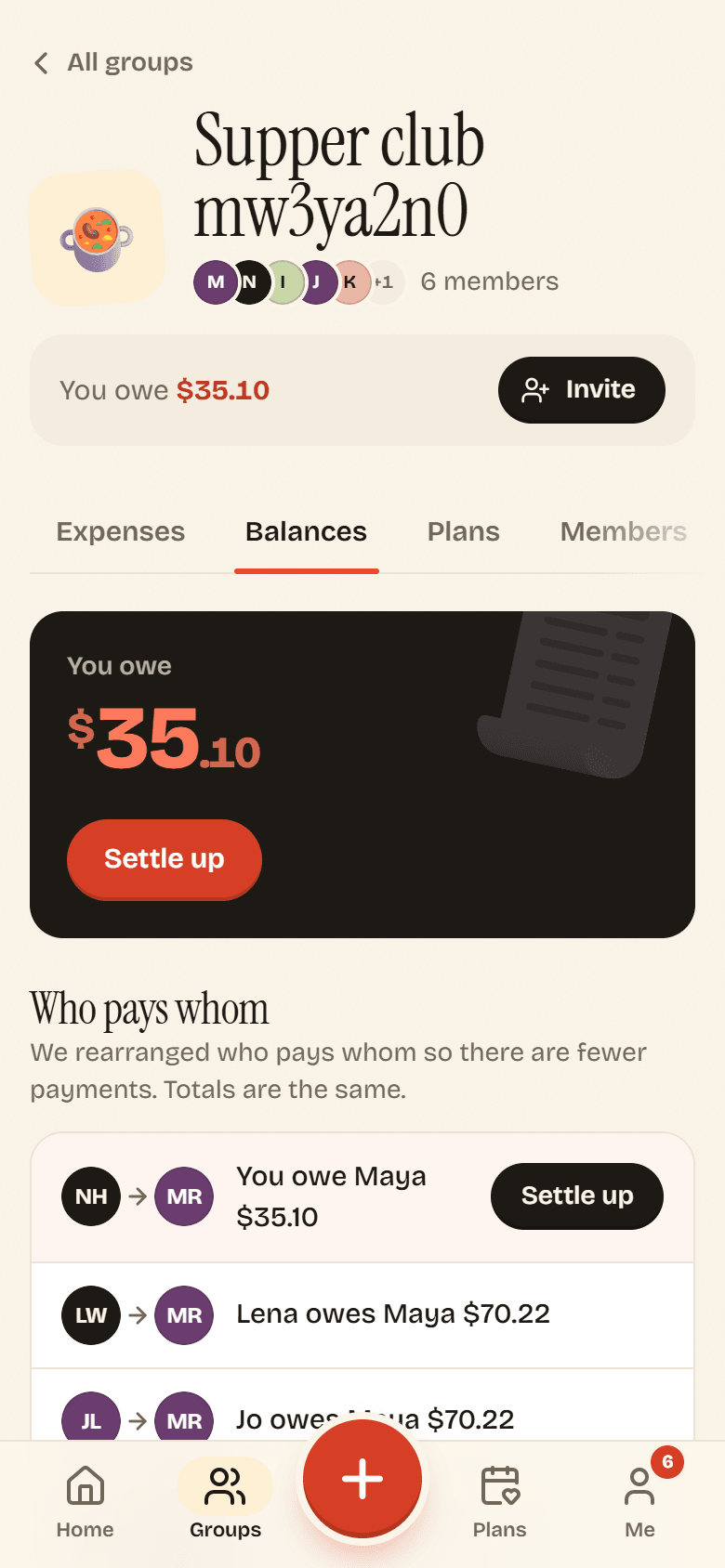
Your balance
Section titled “Your balance”The card at the top is your total in this group: You owe, You are owed, or You are all square. It counts every expense and payment in the group. Settle up starts a payment; see Recording a payment.
Who pays whom
Section titled “Who pays whom”This list says exactly which payments would square the group. Your own rows come first, each with a Settle up button.
Below it, Everyone shows each member’s total: is owed, owes, or settled up.
Simplified debts
Section titled “Simplified debts”Groups simplify debts unless an owner or admin turns it off in Group settings. The setting’s description sums it up: Fewer payments, same totals. Nobody pays more than they owe.
An example
Section titled “An example”Three friends, two expenses:
- Ava paid $60 for groceries for herself and Ben. Ben owes Ava $30.
- Ben paid $60 for concert tickets for himself and Cam. Cam owes Ben $30.
Without simplifying, that is two payments: Ben pays Ava $30, and Cam pays Ben $30. Ben’s money just passes through him.
With simplifying, Potluck looks at where everyone ends up:
| Paid | Their share | Net | |
|---|---|---|---|
| Ava | $60 | $30 | is owed $30 |
| Ben | $60 | $60 | settled up |
| Cam | $0 | $30 | owes $30 |
So the list shows one payment: Cam owes Ava $30. Everyone ends up in the same place, with one payment instead of two.
How it decides
Section titled “How it decides”- It works out each person’s net balance: what they paid, minus their share of everything, adjusted for payments already made.
- It takes the person who is owed the most and the person who owes the most, and has the second pay the first as much as they can.
- It repeats until everyone is at zero.
A group of five never needs more than four payments this way.
Balances across groups
Section titled “Balances across groups”Each group has its own balances. Home adds them up for you under Your balance, and the Friends page shows your one-on-one tabs. Money owed in one group is never moved into another.